How does PEM electrolysis work?
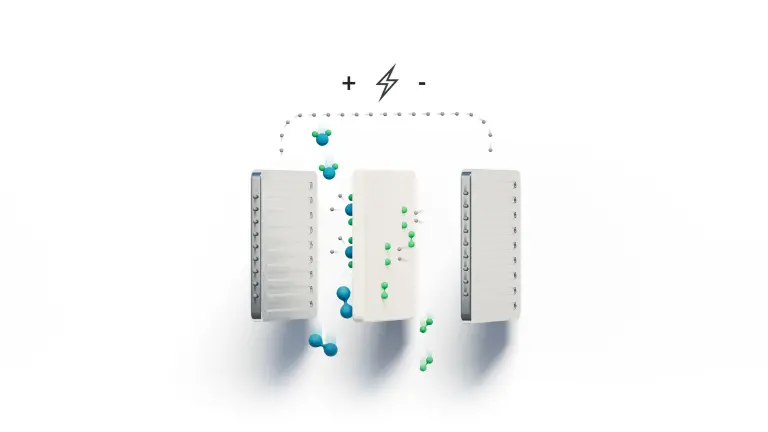
In the PEM electrolysis process, ultrapure water (H₂O) flows around a proton exchange membrane (PEM). Located between the anode and the cathode, this membrane is ionically conductive. When an electric voltage is applied to the electrodes, the water on the anode is oxidized to oxygen (O₂), releasing electrons as well as hydrogen ions. The protons pass through the membrane by diffusion. They then combine with the electrons at the cathode to form hydrogen atoms (H₂). The reaction products of PEM electrolysis are therefore hydrogen and oxygen (H₂ and O₂).
Functional principle of PEM electrolysis
Loading the video requires your consent. If you agree by clicking on the Play icon, the video will load and data will be transmitted to Google as well as information will be accessed and stored by Google on your device. Google may be able to link these data or information with existing data.
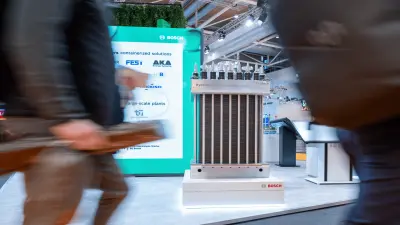
This video demonstrates the process of hydrogen production using PEM electrolysis technology. Purified water is supplied to the Hybrion PEM electrolysis stack, where the electrochemical process takes place inside multiple individual cells. A proton exchange membrane separates the anode and cathode while enabling the movement of protons through the system. By applying electrical energy, water is split into oxygen and hydrogen. Oxygen is formed at the anode, while pure hydrogen is produced at the cathode, enabling an efficient method of hydrogen production.
Overview of electrolysis technologies
PEM water electrolysis uses a solid polymer electrolyte membrane (PEM), also known as a proton exchange membrane, as the ion-conducting medium between the anode and the cathode. This distinguishes it from other water electrolysis technologies, including alkaline water electrolysis (AEL), anion exchange membrane (AEM) electrolysis, which uses an anion-conducting membrane, and high-temperature electrolysis (HTE) based on solid oxide electrolyzer cells (SOECs).
Alkaline Electrolysis (AEL)
Electrolysis with liquid alkaline electrolyte (KOH), proven and cost-effective technology for industrial applications.
- Low investment costs and long service life
- Robust and proven technology
- High space requirement due to low current density
- Less capable of dynamic operation
- Sensitive to CO₂ contamination
Proton Exchange Membrane (PEM)
Operates at low temperature, enables rapid load changes and high hydrogen purity.
- Compact design based on high current densities
- High capability of dynamic operation enabling quick start/stop and ramping times
- High purity of the produced hydrogen, which is needed for certain applications, e.g. fuel cells
- Stack costs still to catch up with AEL due to higher grade materials
Solid Oxide Electrolysis Cell (SOEC)
High-temperature electrolysis with solid ceramic electrolyte, uses steam to produce hydrogen at 700–900 °C.
- High efficiency due to high operating temperatures and potential to use industrial excess heat for steam generation
- Potential for reversible use as a fuel cell
- Potential for co-electrolysis generation syngas (H₂ + CO)
- High material costs and stress
- Slow start-up times and limited technological maturity
Anion Exchange Membrane (AEM)
Combines the advantages of alkaline and PEM technology with the use of cost-effective catalysts.
- Use of inexpensive, non-noble catalysts is possible
- Medium operating temperature (50–80 °C)
- Good efficiency and relatively fast reaction times
- Membrane stability and lifetime are still limited
- Technologically still in the development phase, with limited commercialization
What are the benefits of PEM electrolysis for hydrogen production?
Compared to other electrolysis methods, PEM electrolysis boasts a number of key benefits, such as:
- Higher power density: PEM electrolyzers produce a lot of hydrogen from a small physical footprint. This means smaller systems and saves space.
- Energy efficiency: These systems convert electricity to hydrogen very efficiently. Our stack produces up to 22.9 kilograms of hydrogen per hour, which is equivalent to an efficiency of 4.7 kWh/Nm³ H₂.
- High hydrogen output pressure: PEM electrolysis produces hydrogen at high pressure. Our stack achieves up to 34 bar.
In addition, PEM electrolyzers offer a range of further advantages: they offer maximum flexibility and require very little space as the compact design allows for space-saving and flexible integration into various environments . They can also be scaled with ease as the system is designed for scalability; by combining multiple stacks. Moreover, PEM electrolyzers are very safe and reliable through their mature and reliable technology, making them the ideal complementary technology to renewable energy sources such as wind and solar power for producing green hydrogen.
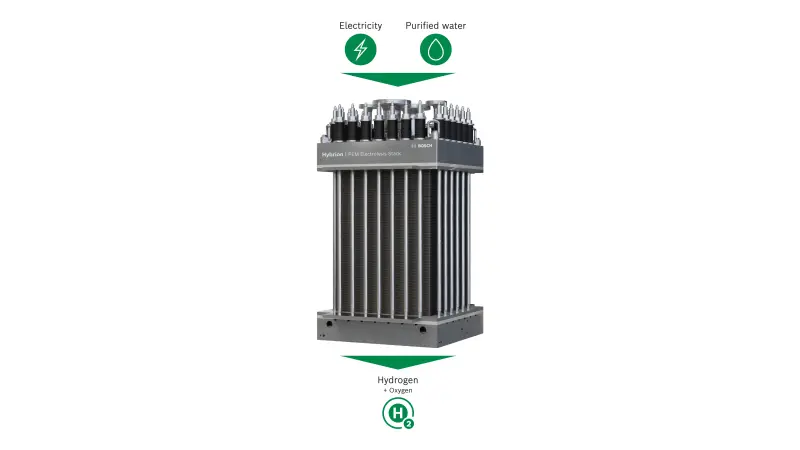
The commissioning of Bosch Hybrion PEM electrolysis stacks for customers starts in 2025. All technical specifications given are development objectives and refer to the beginning of life.