Proton exchange membrane (PEM) water electrolysis for green hydrogen production
Unlock scalable, low-carbon hydrogen production with Hybrion PEM electrolysis stacks and services by Bosch.
Discover hydrogen production with Hybrion PEM Electrolysis Stacks
Dive into the world of hydrogen production and experience our Hybrion PEM electrolysis stacks in 3D. Explore interactively now:
PEM electrolysis – a pathway to low-emission hydrogen production
Hydrogen produced via the proton exchange membrane electrolysis (PEMEL or PEM electrolysis) method is one of the key elements of a low-emission energy economy. It enables the production of green hydrogen by using renewable electricity as the reaction products of this electrochemical process are hydrogen and oxygen. Green hydrogen is a versatile and storable CO₂-neutral energy carrier.
Green hydrogen – an all-rounder in the energy system
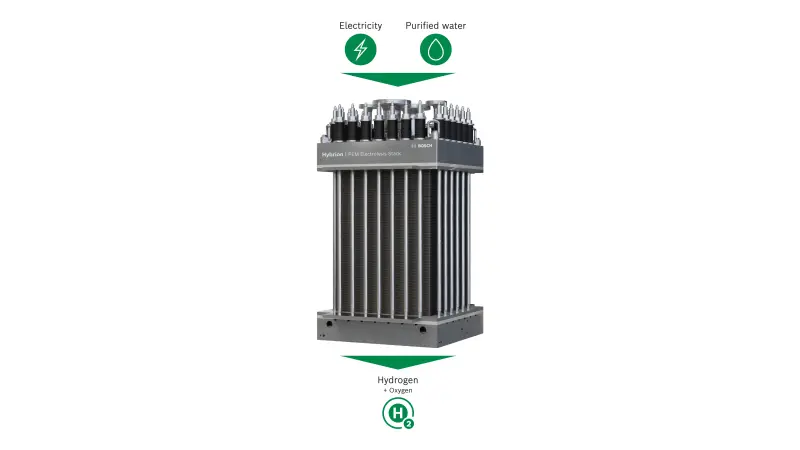
Green hydrogen is generated in electrolysis systems using water and electricity from renewable sources, such as solar or wind energy.
Electrolysis-produced hydrogen is a true all-rounder in industrial processes, transport, and energy sectors, as it is an energy source, a raw material, and an energy storage medium all in one. In its molecular form, it is an energy source. Its potential can be used by converting it into electrons – in other words, it can be used to generate electricity. At the same time, it is gaseous and combustible, so it can be used as an alternative to fossil fuels.
Green hydrogen can be used to decarbonize industries that are unable to dispense with fossil fuels just by switching to electricity. It can also be used in the chemical industry to produce ammonia, methanol, and refinery products. It can be integrated to decarbonize this process.1
Furthermore, hydrogen can play an important role in making the transport sector less dependent on fossil fuels. Especially when utilized as a fuel for commercial and rail vehicles, and as a base for synthetic fuels.
Green hydrogen can be stored, which opens up many possibilities for storing energy in this form on a long-term basis. One particularly promising application is power-to-gas. This involves converting electrical energy into hydrogen and storing it to make it available for a variety of uses. Green hydrogen therefore has the potential to make a key contribution to replacing natural gas, coal, and oil.
Compared to these forms of energy, the crucial difference is that a hydrogen economy is possible without any associated emissions, such as greenhouse gases.
1 Nationaler Wasserstoffrat (2023). Fortschreibung der Nationalen Wasserstoffstrategie – Teil 4: Wasserstoffanwendung in der Industrie [Update of the National Hydrogen Strategy – Part 4: Hydrogen Application in Industry]. Recommendation of WG 5 – Sectoral Strategies.
FAQs about PEM electrolysis and our Hybrion PEM Electrolysis Stacks
Proton exchange membrane electrolysis (PEM electrolysis) is an electrochemical process for producing hydrogen by means of water electrolysis. The process uses an electrolyzer that contains an anode and a cathode. The anode and cathode are separated electrically by a proton exchange membrane, which is also called a polymer electrolyte membrane. When the electrolysis process runs on electricity from renewable energy sources such as solar power, hydropower, or wind power, the hydrogen produced is known as green hydrogen.
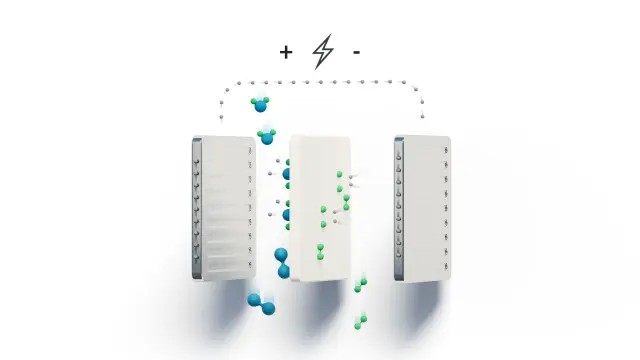
In PEM electrolysis, ultrapure water flows around a proton exchange membrane (PEM). Located between the anode and the cathode, this membrane is ionically conductive. When an electric voltage is applied to both electrodes, the water on the anode side oxidizes to oxygen, free electrons, and hydrogen ions (Oxygen Evolution Reaction, OER). The ions pass through the membrane by diffusion. They then combine with the electrons at the cathode side to form hydrogen gas (Hydrogen Evolution Reaction, HER). The reaction products of PEM electrolysis are hydrogen and oxygen.
A PEM electrolyzer is a system that splits water into its component parts of hydrogen and oxygen by means of an electrochemical reaction. The hydrogen produced in this way is used as an efficient energy source.
We manufacture the most important component of a PEM electrolyzer – the stack, which is, in a sense, the beating heart of water electrolysis.
Compared to other electrolysis methods, such as alkaline electrolysis (AEL), PEM water electrolysis boasts a number of key benefits:
- high power density,
- high energy efficiency,
- high hydrogen output pressure.
In addition, PEM electrolyzers offer a range of further advantages:
- They offer maximum flexibility and require very little space: The compact design of the PEM electrolysis stack allows for space-saving and flexible integration into various environments, from decentralized production to large industrial plants. Its ability to handle a wide operating range makes it highly adaptable to different production needs.
- They can be scaled with ease: The system is designed for scalability; by combining multiple stacks, hydrogen production can be increased to meet the demands of large-scale, energy-intensive industries.
- The process is very safe and reliable: The PEM electrolysis process is a mature and reliable technology suitable for long-term, dependable operation.
Proton Exchange Membrane (PEM) electrolysis has emerged as a key technology for electrolytic hydrogen production. Its high efficiency and fast dynamic response allow it to rapidly adapt to variable renewable energy sources like wind and solar power.1,2 This makes PEM systems, in contrast to conventional alkaline electrolysis, particularly suitable for Power-to-X applications and decentralized energy systems.2
Furthermore, PEM electrolyzers produce high-purity hydrogen1 and can operate at high current densities and elevated pressures, reducing downstream compression requirements.1,2 These characteristics make PEM electrolysis highly attractive for mobility applications such as hydrogen refueling stations and fuel cell vehicles, where compact system design and high hydrogen quality are essential.
In addition, the technology is applied in industrial sectors including chemical production, energy storage, and grid stabilization, where flexible and reliable hydrogen generation is required for the transition toward a low-carbon energy infrastructure.2
1 Koponen, J., Kosonen, A., Ruuskanen, V., Huoman, K., Niemelä, M., & Ahola, J. (2017). Control and energy efficiency of PEM water electrolyzers in renewable energy systems. International Journal of Hydrogen Energy, 42(45), 29648-29660.
2 Hancke, R., Holm, T., & Ulleberg, Ø. (2022). The case for high-pressure PEM water electrolysis. Energy Conversion and Management, 261, 115642.
A PEM electrolisisyzer stack is the core assembly inside a Proton Exchange Membrane (PEM) water electrolyzer, a component that splits water into hydrogen (H₂) and oxygen (O₂) using electricity. It is a collection of many individual cells connected electrically in series and hydraulically in parallel. Each cell performs water electrolysis and stacking them increases total hydrogen production.
At the heart of each cell is the Catalyst Coated Membrane (CCM), an electrically insulating polymer that allows protons to pass through. Water is supplied to the anode side of this membrane via a metallic, Porous Transport Layer (PTL). At the anode, a catalyst splits the water into oxygen, protons, and electrons. While the electrons are conducted away, the protons migrate directly through the membrane to the cathode. There, they react to form hydrogen gas, which is then removed through a porous carbon Gas Diffusion Layer (GDL).
We manufacture PEM stacks in industrialized series production.
In PEM electrolysis, ultrapure water flows around a proton exchange membrane (PEM). Located between the anode and the cathode, this membrane is ionically conductive. When an electric voltage is applied to both electrodes, the water on the anode side oxidizes to oxygen, free electrons, and hydrogen ions (Oxygen Evolution Reaction, OER). The ions pass through the membrane by diffusion. They then combine with the electrons at the cathode side to form hydrogen gas (Hydrogen Evolution Reaction, HER). The reaction products of PEM electrolysis are hydrogen and oxygen.
The commissioning of Bosch Hybrion PEM electrolysis stacks for customers starts in 2025. All technical specifications given are development objectives and refer to the beginning of life.