Decentralized Hydrogen Production with Hybrion PEM Electrolysis Stacks in Bamberg
Loading the video requires your consent. If you agree by clicking on the Play icon, the video will load and data will be transmitted to Google as well as information will be accessed and stored by Google on your device. Google may be able to link these data or information with existing data.
Project overview
Use case
Mobility application in long-term duration testing of fuel cell power modules
Location
Bamberg, Germany
Operating since
October 2025
Electrolysis capacity
2.5 MW
Hydrogen production rate
~ 1 t/day
Energy source for electrolysis
Wind and solar power
Project description
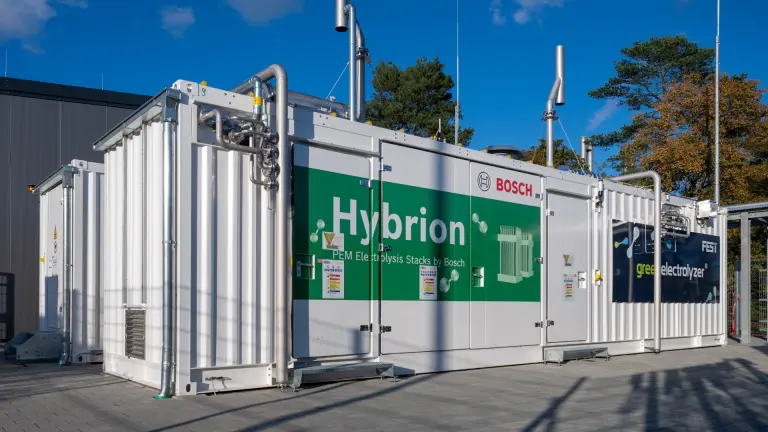
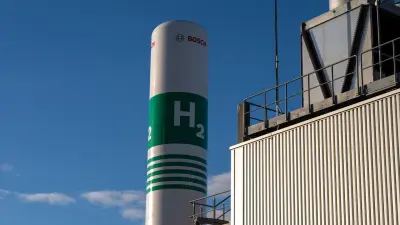
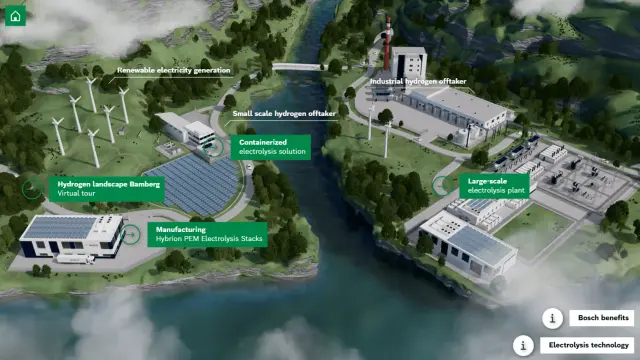
At the Bosch H2 lead plant in Bamberg, a local hydrogen ecosystem is established. To test the Bosch fuel cell power modules (FCPM), we rely on on-site hydrogen production:
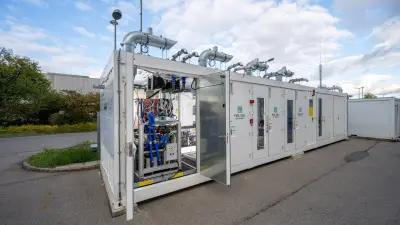
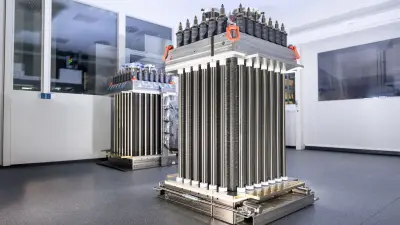
Two of our Hybrion PEM electrolysis stacks, produced in Bamberg, form the heart of the 2.5 MW electrolysis container, which converts water into hydrogen and oxygen using renewable electricity. The hydrogen produced in this way is used for endurance testing of the fuel cell power modules, which in turn generate electrical energy that flows back into the electrolyzer and contributes to its energy requirements.
The electrolysis solution…
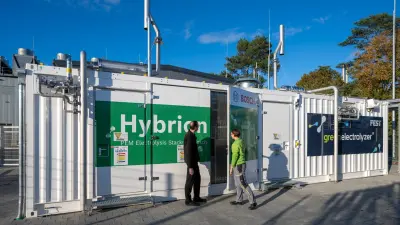
To supply the lifetime container with hydrogen for endurance testing of the fuel cell power module, we operate an 2.5 MW electrolyzer on-site in Bamberg.
The two integrated Hybrion PEM electrolysis stacks are engineered for high performance and produce approximately one ton of hydrogen per day at an output pressure of up to 34 bar. This amount is enough to power an electrically operated 40-ton truck with a fuel cell power module for up to 14,000 kilometers.
Equipped with sensor technology, the electrolysis container continuously collects performance data. We gain deep insights into operational data, enabling us to continuously optimize our Hybrion stacks. The collected data also empowers us to best support our customers with their operational strategies.
...integrated in the hydrogen landscape in Bamberg, Germany
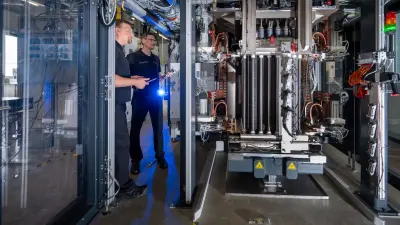
End-of-line testing for highest quality standards
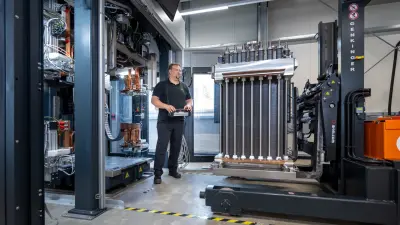
Before being integrated into an electrolyzer, the Hybrion stacks undergo testing in the Bosch plant in Bamberg, where they are also manufactured. This is how we ensure the robustness and reliability of each stack under real operating conditions. To do this, various load profiles are simulated to test each stack's response to electrical fluctuations.
Additionally, we carry out an activation process for all Hybrion stacks to ensure they are ready for immediate integration into our customers' electrolyser systems. During this process, we carry out electrochemical commissioning and run in the stack to thoroughly flush out ions. This significantly reduces overall commissioning times at the customer's site.
The same applies to the Hybrion stacks integrated into the electrolyser container by the plant manufacturer FEST, in collaboration with our Bosch Technical Customer Support Team. Integrated into a container, the Hybrion stacks are flexible and scalable – ideal for decentralized applications such as the local energy supply for the hydrogen landscape in Bamberg.
Our expertise along the entire hydrogen value chain
By operating an electrolysis system and its infrastructure at our Bamberg site, we gain valuable practical experience as well. This makes us experts in the entire hydrogen value chain – from the production of electrolysis stacks to integration and daily operation. We continuously deepen our in-depth system expertise, which we use for product optimization and pass on to our customers.
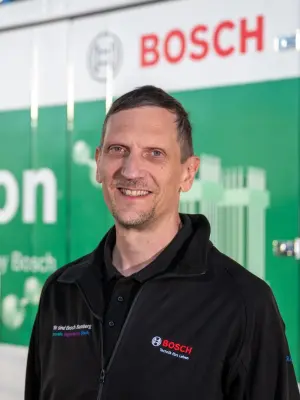
This project is a real-world blueprint for integrating our Hybrion Stacks. And we are not only providing this core technology for electrolysis. We also act as the operators, infrastructure providers, and even customers for the hydrogen we produce.
Project success at a glance
Technology in practice
2.5 MW electrolyzer with Hybrion stacks delivers more than 1 ton of hydrogen per day.
Holistic expertise
From the production of the stacks to the operation of the electrolysis container and its infrastructure.
Hydrogen production from renewables
Thus meeting the EU requirements for renewable hydrogen.
The comissioning of Bosch Hybrion PEM electrolysis stacks for customers starts in 2025. All technical specifications given are development objectives and refer to the beginning of life.