Water Purification for Electrolysis: Why Electrolysis Needs Ultrapure Water
Green hydrogen made out of renewable energies promises a clean, sustainable energy future, often depicted as a simple equation: renewable electricity + water = low carbon fuel. However, beneath this seemingly straightforward formula lies a critical, yet frequently underestimated, challenge: the immense demand for water. But not just any water - ultrapure water. What if the most crucial ingredient is the hardest to get right?
-253°C | The Bosch Hydrogen Expert Talk #13: Water purification – elixir of life
Loading the video requires your consent. If you agree by clicking on the Play icon, the video will load and data will be transmitted to Google as well as information will be accessed and stored by Google on your device. Google may be able to link these data or information with existing data.
In this episode, Dr. Wolfgang Schleifenbaum, Head of Product Area Hydrogen at Bosch Manufacturing Solutions | BMG, explains why water purification is the first step to electrolysis.
Why is tap water not suitable for electrolysis?
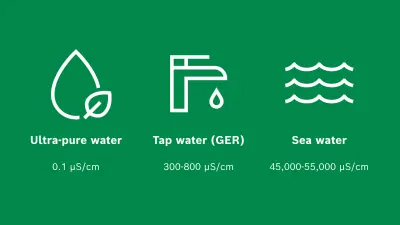
Running an electrolyzer on tap water would impair the electrochemical process in terms of efficiency and system lifetime. Ordinary tap water contains contaminants like salts, minerals, and metal ions - these would lead to undesirable side reactions in the electrolysis process and render the system inoperable in a very short time.
We measure the quality of the water in terms of electrical conductivity. An electrolyzer needs ultra-pure water, which has a conductivity of only 0.1 micro siemens per centimeter. Tap or sea water are many times more impure.
Source: Test-Wasser.de (n.d)
Where is the water for electrolysis supposed to come from?
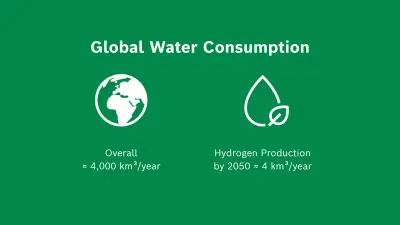
In hydrogen production via electrolysis, water demand is a common concern. But experts state that the overall amount needed for hydrogen production by 2050 with approximately 4 km³ per year is small compared to today's global water consumption of around 4,000 km³ per year.
Decentralized Green Hydrogen Production: Opportunities and Challenges
The availability of green hydrogen is essential for advancing the decarbonization of industrial sectors. Green hydrogen is produced via electrolysis, using electricity generated from renewable energy sources.
While green hydrogen promises a clean energy future, its production is highly water-intensive, requiring millions of cubic meters of ultra-pure water on an industrial scale.
This significant demand for high-purity water directly exposes the critical issue of location: the remote areas best suited for renewable power generation, such as arid deserts and windy coastal regions, are often the precise locations where freshwater resources are scarcest. This geographical mismatch between energy potential and water availability creates the following key challenges:
Key challenges for water purification
Arid regions and low maintenance
The best locations for solar and wind energy are often the driest, creating a fundamental resource conflict, alongside trying to keep a low maintenance level.
Intermittency
The start-stop nature of renewable energy is a major challenge for conventional water purification technologies.
What requirements must a water purification system fulfill?
- can cope with rough offshore conditions or water scarcity in arid regions with intermittent energy supply.
- ensure low energy consumption and high efficiency.
- are especially robust to guarantee minimal maintenance and maximum reliability.
BMG Pure Water System
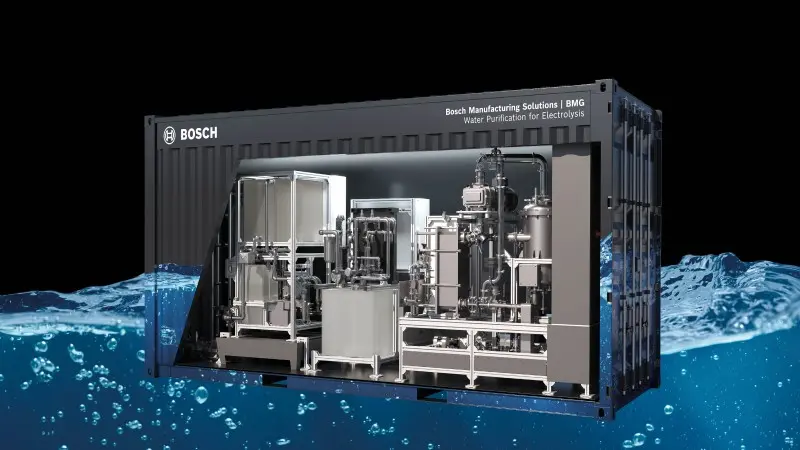
Bosch Manufacturing Solutions | BMG introduces a containerized, standalone water purification system tailored for hydrogen projects. It’s designed to meet the unique challenges of hydrogen production.
-
Mechanical Vapor Compression Distillation
An energy-efficient core process for robust purification.
-
Electrodeionization Unit
A "polishing" step to achieve the required < 0.1 µS/cm ultrapure water quality.
-
Anti-Scaling System
Ensures a sustainable process without adding pollutants to the environment.
Want to find out more about the BMG Pure Water System?