Anti-Aging for Stacks?
In this episode, we address a core question: Is the economic viability of hydrogen critically dependent on the longevity of its components? While innovations and record-breaking achievements often dominate headlines, the durability of facilities also determines long-term success. In Tilburg, Netherlands, we meet Piotr Krzywda, our expert on the lifetime and degradation of electrolysis stacks. He offers insights into the factors influencing the long-term costs of hydrogen and explains how his team, through targeted investigations of degradation processes, optimizes the lifespan of the next product generations.
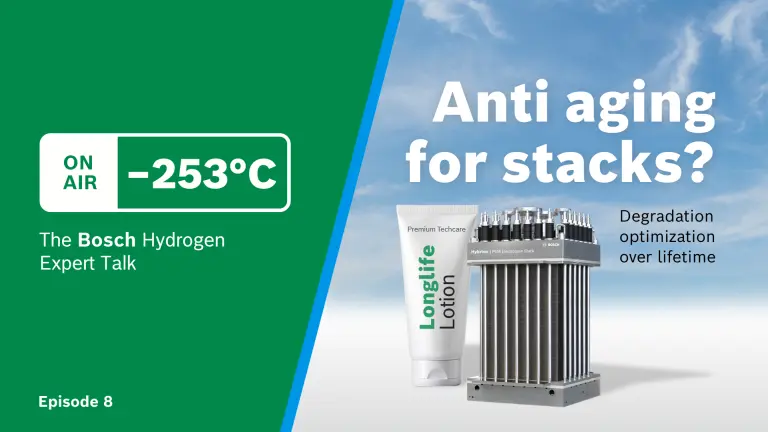
-253°C | The Bosch Hydrogen Expert Talk #8: Anti-aging for stacks?
Loading the video requires your consent. If you agree by clicking on the Play icon, the video will load and data will be transmitted to Google as well as information will be accessed and stored by Google on your device. Google may be able to link these data or information with existing data.
In this episode, Piotr Krzywda, Product and Process Engineer at Bosch, explains how he and his team optimize the lifespan of the next product generations through targeted stress tests.
Investigation of degradation processes
The focus of this episode is on optimizing the next generation of electrolysis stacks. Piotr explains that while the degradation process cannot be eliminated, the product lifespan can be optimized through targeted research into aging processes in components such as anode catalysts and membranes. He also explains how durability influences the Levelized Cost of Hydrogen (LCOH).
What are Levelized Cost of Hydrogen?
The LCOH are total expenses involved in producing hydrogen throughout its entire lifecycle, including both capital (CAPEX) and operational costs (OPEX).*
Making hydrogen more economical: The interplay of cost, efficiency, and durability
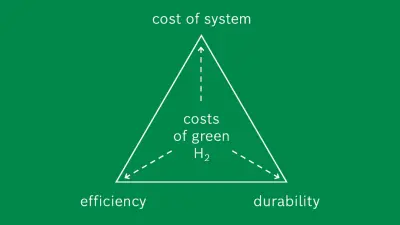
Lowering the Levelized Cost of Hydrogen (LCOH) requires an optimal balance between system costs, efficiency, and durability. Unilaterally maximizing durability would lead to undesirably high manufacturing costs or efficiency losses.
Since durability of systems are not easily predictable, a deep understanding of the mechanical and electrochemical processes within the electrolyzer cell is essential. Our experts analyze the fundamental degradation mechanisms of each component and deliberately provoke failures through accelerated stress tests to quickly gain valuable insights.
How targeted stress tests improve stack design
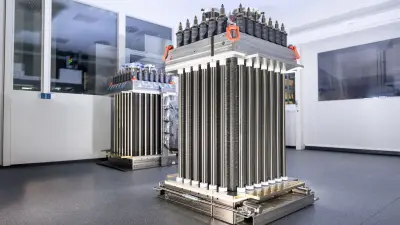
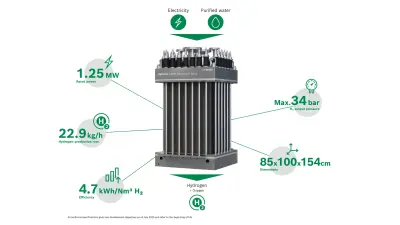
To optimize the durability of Hybrion PEM electrolysis stacks, our experts deliberately induce failures through accelerated stress tests. This allows us to gain crucial insights into weak points in a short amount of time.
The membrane serves as a key example: Each electrolytic cell features a central membrane. It separates hydrogen and oxygen and must withstand high temperatures and pressures throughout its entire lifespan. To improve its performance, the membrane is mechanically stressed to determine how much it can endure and how easily it can be damaged. This knowledge enables our team to further optimize the stack design.
* European Hydrogen Observatory; Levelised Cost of Hydrogen (LCOH) Calculator Manual; https://observatory.clean-hydrogen.europa.eu/tools-reports/levelised-cost-hydrogen-calculator; accessed September 24, 2025.