A Deep Dive into Testing Hybrion PEM Electrolysis Stacks
The climate-friendly hydrogen economy powered by renewable energy is set to grow – ideally on a massive and immediate scale. The foundations for high-performance electrolysis stacks have long been in place, but mass production of hydrogen takes more than just the technology. What's currently missing are standardized methods to consistently test and compare performance and quality. In the Bosch Hydrogen Expert Talk, Dr. Philipp Mayr, hydrogen test engineer in the testing and reliability team at Bosch in Linz, explains how test benches and measurement methods play a role in the further development and industrialization of electrolysis stacks.
-253°C | The Bosch Hydrogen Expert Talk #10: Stacks to the test
Loading the video requires your consent. If you agree by clicking on the Play icon, the video will load and data will be transmitted to Google as well as information will be accessed and stored by Google on your device. Google may be able to link these data or information with existing data.
In this episode of the Bosch Hydrogen Expert Talk, Dr. Philipp Mayr explains how test benches and measurement methods are important for the further development and industrialization of electrolysis stacks.
Accelerating Hydrogen Innovation: The Role of Efficient Testing
The development of robust and reliable PEM electrolyzer technology is fundamentally predicated on comprehensive testing and validation processes.
For example, we at Bosch consider:
At Bosch, the generation of reliable results in hydrogen technology is underpinned by continuous, critical testing. We constantly evaluate whether our measurements accurately capture the real processes within the stack, or if the results are influenced by the test procedure or the prevailing boundary conditions. For this evaluation, results from measurements on smaller test samples are compared with the test results of the actual stack. We meticulously design our test bench infrastrucure for sufficient agility to match the dynamic pace and inherent volatility of the hydrogen market.
What happens on a test bench?
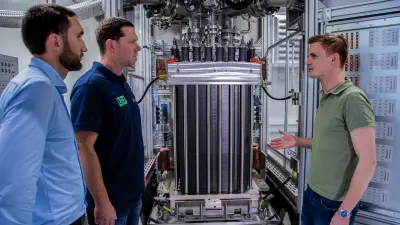
We test the Hybrion PEM electrolysis stack under clearly defined boundary conditions. With the data from our measurement of the stack behaviour, we draw our conclusions and improve the stack. The test bench controls five major parameters:
- anode pressure
- cathode pressure
- electric power supply
- anode water flow
- anode circuit temperature.
Can innovation and standardization be reconciled?
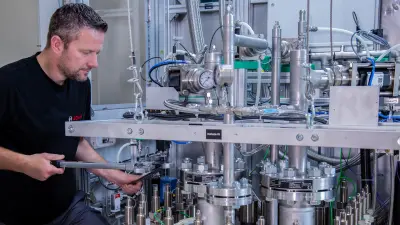
At Bosch, our testing philosophy is based on two fundamental requirements: to maintain the agility for conducting special tests while simultaneously upholding rigorous standardization. This balance is crucial for enabling comparative analysis of future stack performance against historical data. A core contribution in Linz is the active drive for standardized testing procedures.