Hydrogen at Large Scale: From Strategy to Reality
How do we turn big visions into real-world impact? In the Bosch Hydrogen Expert Talk, Dr. Sopna Sury, Chief Operating Officer Hydrogen RWE Generation*, shares insights from RWE’s Lingen pilot plant and explains how infrastructure, pragmatic regulation, and reliable demand-side incentives will finally kick-start the green hydrogen market at scale.
-253°C | The Bosch Hydrogen Expert Talk #11: No time to H₂esitate
Loading the video requires your consent. If you agree by clicking on the Play icon, the video will load and data will be transmitted to Google as well as information will be accessed and stored by Google on your device. Google may be able to link these data or information with existing data.
In this episode of the Bosch Hydrogen Expert Talk, Dr. Sopna Sury explains how RWE will kick-start the green hydrogen market at scale.
Hydrogen Project in Lingen
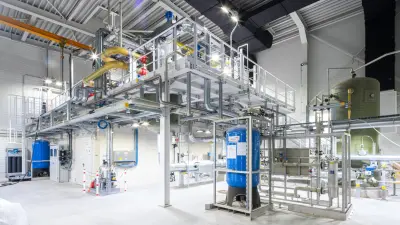
In Lingen, RWE has launched a H2 pilot plant with a capacity of 14 MW . The electrolysis plant produces up to 270kg hydrogen per hour . They are trialing with this pilot plant two different technologies: PEM and alkaline electrolysis .
The H2 pilot plant is part of a bigger plan: It plays a key role In the GET H2 Nukleus project, where RWE is building a 300 MW electrolysis plant.
From Pilot to Large-Scale: The GET H2 Nukleus Project
The H2 pilot plant in Lingen is a critical stepping stone and enabler for the much larger GET H2 Nukleus project , where RWE is constructing an impressive 300 MW electrolysis plant . The insights gained here are directly informing the scaling and success of this major facility, which will serve as a central hub for Germany's hydrogen economy.
The project aims to…
- Generate green H2 for industrial customers at a commercial scale
- Connect H2 production and offtake with a 130km hydrogen network
- Establishing the first publicly accessible hydrogen infrastructur
Reliable Infrastructure as the Key to Hydrogen Markets
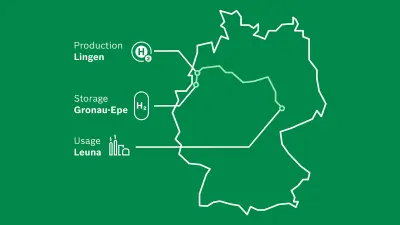
A fast and dependable hydrogen core network is essential to connect supply and demand. RWE has been a pioneer, delivering early and securing a 15-year offtake agreement for around 30,000 tons per year , demonstrating how robust pipeline infrastructure underpins market success. Timely implementation is the foundation for a functioning hydrogen market across Germany.
What does the market need to scale up from pilot projects to full industrial deployment?
Dr. Sopna Sury identifies three main factors:
Infrastructure
Planning certainty about the infrastructure is essential.
Pragmatic regulations
More pragmatic regulations to overcome the cost-difference between natural gas, grey hydrogen and green hydrogen.
Demand incentives
Suppliers need reliable industrial off-takers. Off-takers need planning certainty to commit to long-term offtake agreements.
Vision 2050: An Integrated Energy Landscape
Looking ahead to 2050, the goal is a connected energy landscape that breaks down traditional silos. The key to this is the concept of sector coupling, in which electricity ("electrons") and gaseous energy carriers ("molecules") are treated as an integrated, systemic whole. In this model, renewable energies and battery storage are intelligently linked with the hydrogen economy. Hydrogen serves as a crucial bridge to enable long-term storage and ensure the necessary flexibility in the system. Controlled by artificial intelligence (AI), we are creating a resilient, self-sustaining, and fully decarbonized energy system.
*At the time of recording, Sopna Sury held the position of COO Hydrogen at RWE Generation. Subsequent to the recording and during post-production, her role was updated: Effective April 1st, she will take on the role of CEO RWE Renewables Europe & Australia. The hydrogen business responsibilities have additionally been assigned to Nikolaus Valerius, CEO of RWE Generation.